Our Origins
From the Calabar coast to the heart of Accra — the founding story of the Quarcoopome family and the legacy of John Nii Okutu Quarcoopome.
John Nii Okutu
Quarcoopome
“He came not just as a man, but as the seed of a dynasty — planting roots so deep that generations would draw strength from them.”

The great coastal migration — from Calabar and Yoruba lands to the shores of Accra, circa 1824
From Calabar to Accra
The story of the Quarcoopome family begins not in Accra, but far to the east along the Cross River — in the verdant lands of Calabar, where the Yoruba and Efik peoples had built thriving communities of trade, culture, and deep spiritual tradition.
In those days, the West African coast was alive with movement. Canoes carved from ancient iroko trees carried merchants, pilgrims, and dreamers between the great ports of the Bight of Biafra and the Gulf of Guinea. John Nii Okutu Quarcoopome was one such traveler — a young man of Yoruba and Calabar lineage who looked westward toward a new horizon.
The journey was neither short nor safe. The coastal waters demanded respect, and the overland paths through dense tropical forest tested the resolve of even the hardiest traveler. Yet he pressed on, driven by something older than commerce: the ancestral belief that a man must find the land that will call him home.
When he finally reached the settlement of Old Accra, he found a world unlike any he had known. The Ga people had built their lives upon these shores for centuries, their language and customs shaped by the rhythm of the Atlantic. But Accra was also a crossroads — a place where Fante traders, Asante merchants, European factors, and coastal peoples mingled in the salt air.
John Nii Okutu did not merely settle. He belonged. He learned the Ga tongue, honored the customs of his new community, and embraced the spiritual life of coastal Accra. Yet the Yoruba fire in his blood never dimmed. He gave his children names that bridged both worlds. He carried the memory of Calabar in his bearing, even as he planted new roots in Ga soil.
“To leave your homeland is an act of courage. To make a new land your own, without forgetting the old, is an act of wisdom. John Nii Okutu did both.”
— Family Oral Tradition
Ancestral Heritage
Adopted Identity
Birth Origin
Founding Home
Cultural Duality
The early Quarcoopome household was a living bridge between two worlds — where Yoruba gods walked beneath Ga roofs, and Nigerian drums echoed through Accra streets.
The Shango shrine — a living testament to Yoruba spiritual tradition preserved within the Quarcoopome household
SHANGO
Long before the Quarcoopome name became known in Accra, the thunder of Shango rolled across the hills of Yorubaland. The god of fire, lightning, and justice was more than a deity — he was the heartbeat of a people who carried their sacred fire wherever they traveled.
Family legend holds that Ataa Kyei Quarcoopome — the eldest son of John Nii Okutu and a revered herbalist — brought the Shango god with him from Yoruba land when the family migrated to Accra. It was not merely an object he carried, but a covenant: the promise that the ancestral fire would never be extinguished, even in foreign soil.
That sacred trust endures today. The Shango shrine still resides within the original Quarcoopome family house at Atukpai, nestled in the heart of Accra beside the Central Post Office building. For nearly two centuries, it has stood as a silent sentinel — a bridge between the Yoruba homeland and the Ga soil that became home.
Within those weathered walls, the shrine has witnessed the full arc of family history: the births, the departures, the celebrations, and the quiet prayers whispered before ancient ritual objects. It is a living museum of faith — not frozen in time, but breathing with the generations who have tended it.
“The fire that Ataa Kyei carried across the land still burns. Shango does not forget his children, and we do not forget him.”
— Quarcoopome Family Oral Tradition
Spiritual Origin
Accra, Ghana
The Agbe (Bata) drums — Yoruba rhythm carried across the coast and planted in the heart of Accra
AGBE DRUMS
When John Nii Okutu set foot on the shores of Accra, he did not arrive alone. With him came a traveling company of drummers, singers, dancers, and performers — a mobile cultural embassy that carried the soul of Yorubaland in every beat, step, and song.
Among their most treasured possessions were the Agbe drums — known also as the Bata drums — sacred instruments carved from ancient wood and brought all the way from Nigeria. These were not merely musical tools; they were vessels of spiritual communication, each rhythm a language that spoke to gods and ancestors alike.
The performances they gave on the streets of early Accra were extraordinary. They drummed and danced with abandon, filling the salt air with the pulse of home. But they also displayed acts that bordered on the miraculous: carrying pots of burning fire without injury, swallowing knives and broken glass without harm, cutting themselves with blades that drew no blood. These were not mere entertainments — they were signs of spiritual protection, proof that the gods walked with them.
The legacy of the Agbe drums found its greatest champion in Nii Lante Quarcoopome, son of Ataa Kyei, who was appointed Leader of the Agbe Drum and took the name Nii Agbe Lante Quarcoopome. Under his leadership, the drums found new resonance, aided by the Tabon people who shared the Yoruba musical fire.
When Nii Agbe Lante passed, his step-sister Naa Mantenye MaNaa Quarcoopome — a gifted singer of Yoruba songs — assumed leadership of the drum tradition. Yet after her time, the flame within the Quarcoopome family dimmed. The Agbe drums passed into the custody of the Tabon people, who have preserved and protected them ever since.
Today, that ancient rhythm lives on. The Tabon people now teach the Agbe drum at the University of Ghana, Legon Cultural Centre — a full circle from the streets of Old Accra to the halls of learning, ensuring that the beat John Nii Okutu carried across the coast continues to echo through Ghanaian culture.
“The drum does not forget the hands that first beat it. Even when the rhythm passes to new keepers, the memory of its origin remains forever Quarcoopome.”
— Family Oral Tradition
Origin of the Drums
Stage of Performance
Legacy Preserved
Family Timeline 1824 – Present
Photo Archives
A curated collection of images from the founding era and early generations of the Quarcoopome family.
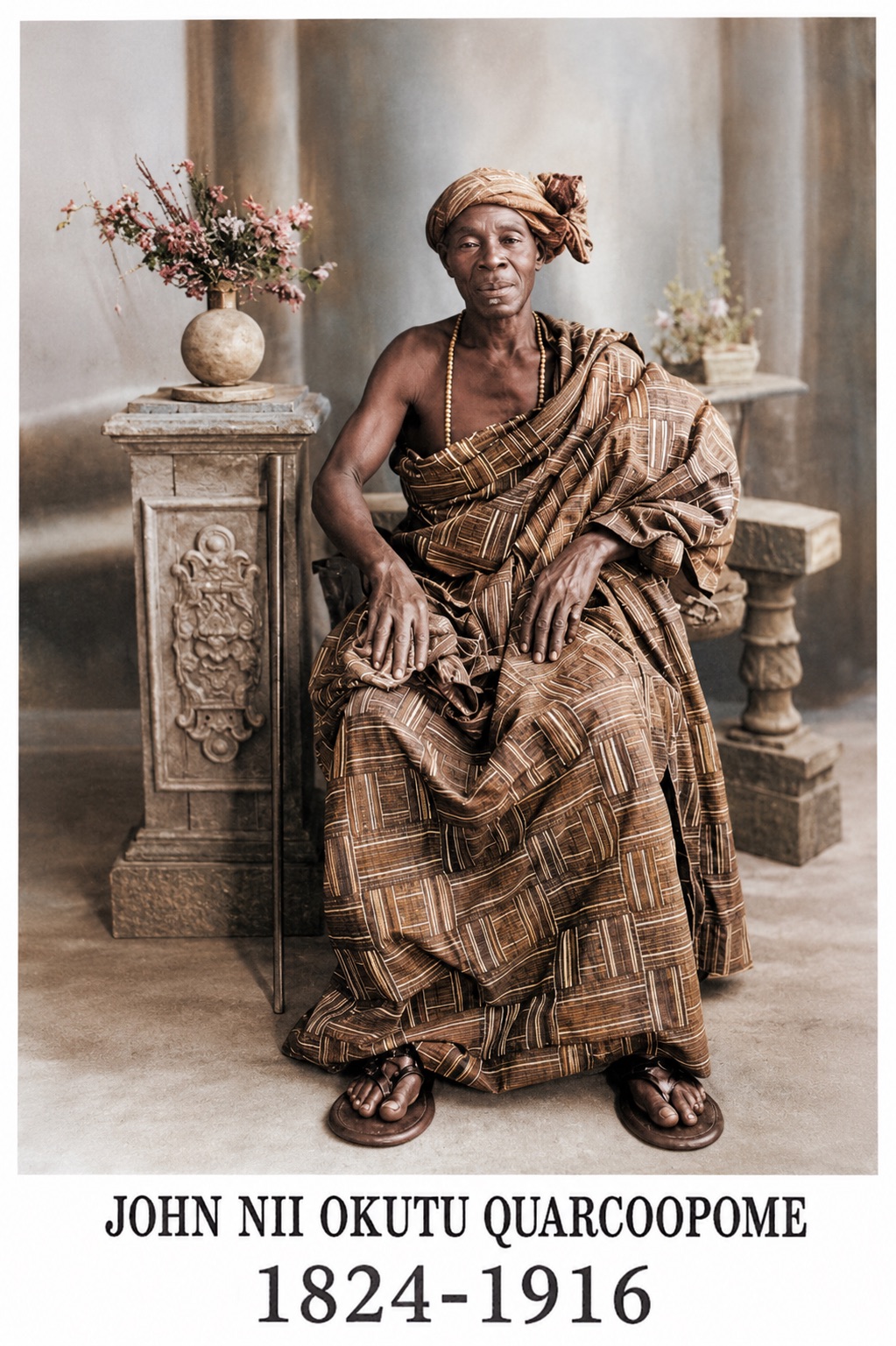
John Nii Okutu Quarcoopome — Founding Patriarch
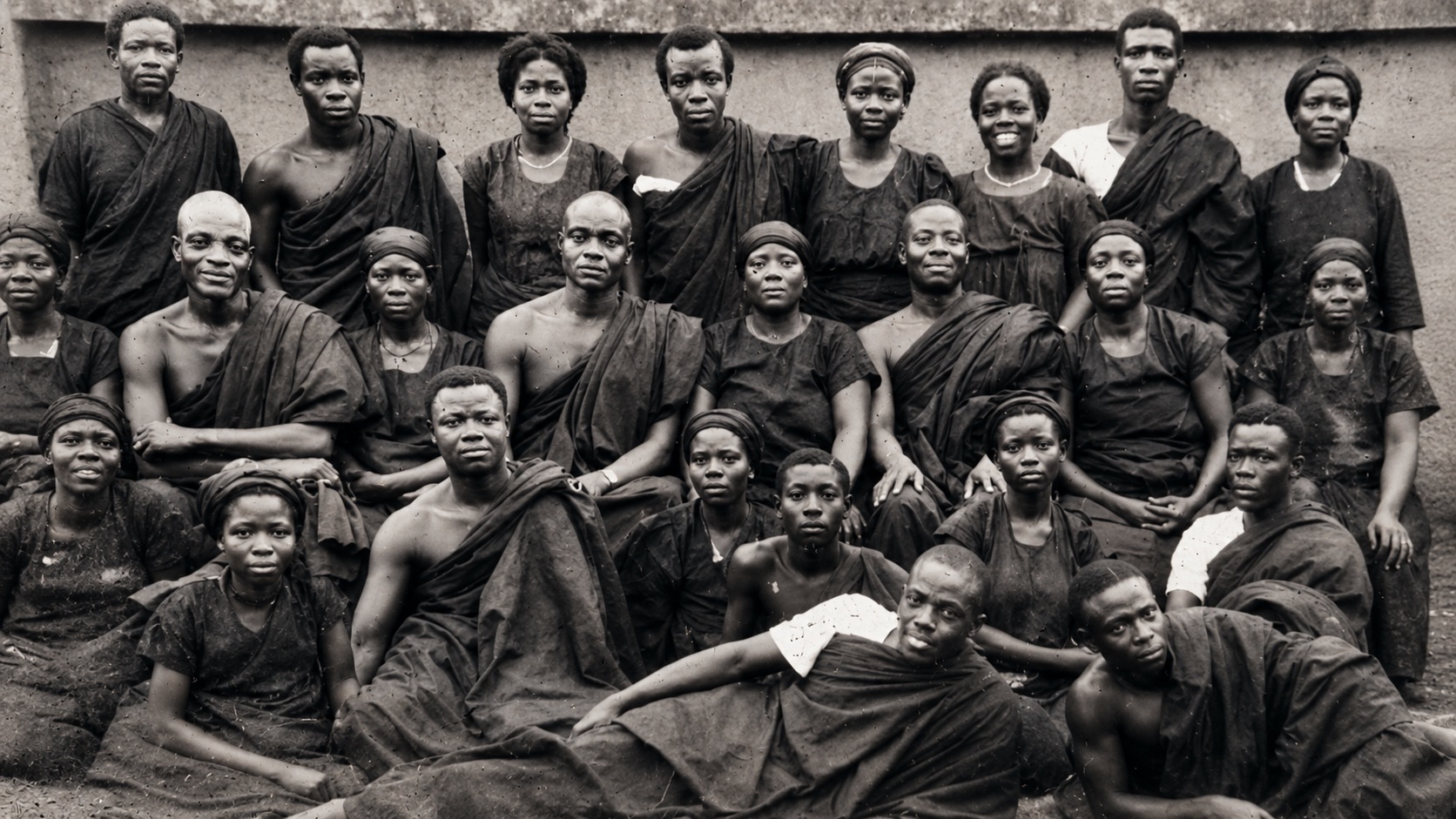
The Quarcoopome family at work, early settlement
Old Accra street scene — the family's new home
The founding patriarch's arrival — artistic impression
The Complete Story
Dive into the full historical account of John Nii Okutu Quarcoopome and the founding of the family dynasty — documented in detail with records, narratives, and photographs.
The Quarcoopome family name first echoed through the dusty corridors of Old Accra in the year 1824, carried upon the shoulders of a young man who had journeyed from the distant Calabar coast. John Nii Okutu Quarcoopome did not arrive with wealth or title — he arrived with courage, with purpose, and with an unyielding determination to plant roots in a land that would one day call him its own.
In those early days, Accra was a world in transition. The Ga people had established their settlement along the coast, European traders maintained their forts, and merchant communities from across West Africa converged in the bustling port. Into this crucible of culture and commerce stepped a man whose very presence would reshape the landscape of family, community, and legacy for generations to come.
PDF Document · JNOQ Family Heritage